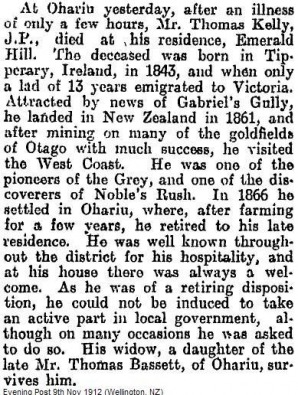
Three of my great great grand uncles, Michael, Thomas and William Kelly, were miners.
Their parents were Cornelius Kelly and Mary Moloughney of Dualla, Tipperary, Ireland.
Michael was born there in 1836, Thomas in 1843 and William in 1846.
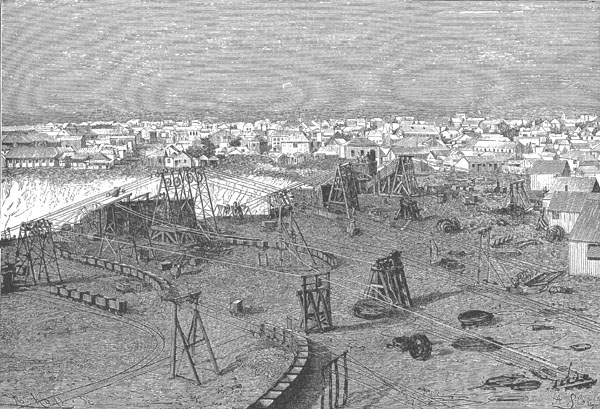
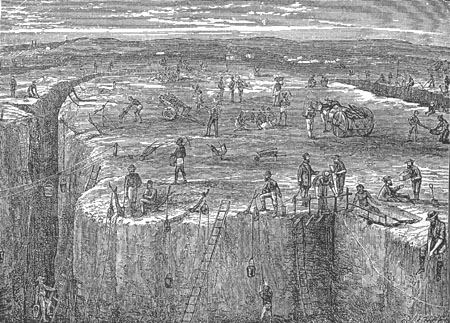
Michael went to Kimberley, South Africa and I am presuming he was a miner there as he did very well for himself.
Michael contracted tuberculosis and came to his sister, Alice, at the Cross Keys Hotel Essendon in Victoria, Australia where he died of the disease six months later in April 1898.
In his Will he left quite a lot of money to family members.
Michael’s younger brother, Thomas Kelly migrated to Australia in 1858 at only 13 years of age along with two other brothers, John and William.
They arrived just in time for their sister’s wedding that same year.
Thomas then moved on to New Zealand, obviously drawn by the gold rushes there.
He also did well from mining.
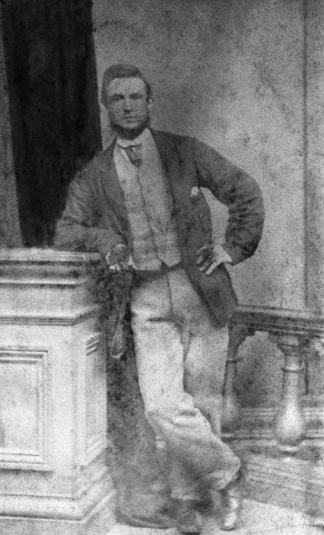
Thomas Kelly
The above photo is courtesy of the late Brigid Simpson and her sister Mary.
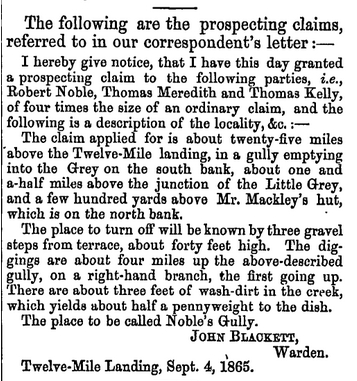
Thomas was one of three men involved in “Noble’s Rush” on the Grey River , South Island of New Zealand.
Robert Noble was granted the prospector’s claim on a tributary creek of the Big Grey, just above Mackley’s station: five hundred men were there to see Noble’s party of three win seventeen pounds’ weight of gold in their first week’s wash up;
Thomas died in 1912 at Ohariu Valley, New Zealand.
William Kelly was much harder to find but mention in his brother Michael’s Will states he was a “speculator” for West Australian Mining.
Apparently a “speculator” is another term for a miner.
The only William Kelly I could find on further searching was the death of a William Kelly in 1899 in Queensland.
His parents were named as Con Kelly and Mary O’Loughlin.
I’m told the surname Moloughney is pronounced with the ‘gh’ as MolloKney which I have read is also interchangeable with McLaughlin etc.
William’s occupation was miner.
~~~~~~~~
I’m lucky to have a couple of little books written years ago by family members about their experiences in the Australian goldfields.
In about 1891 my maternal 3rd great grand uncle, Edward Hulme, wrote a small book called “A sketch of Life”.
It was an account of his emigration from England to Australia and in it there are a couple of paragraphs about his mining experience and even an account of his “200 mile tramp through the bush” which was from Melbourne to the Beechworth goldfields.

OFF TO THE DIGGINGS.I started alone with swag, blankets, billy, pannikin, etc., in orthodox style, for a 200 miles’ tramp through the bush. (See frontispiece.) This, however, was not much of an undertaking for me, as I was a great pedestrian, could do my six miles an hour easy, and often over 50 miles per day on my sketching tours in the “Old Country ;” being tall (fully six feet), I had a good stride. At that time the Sydney Road was only formed a few miles out of Melbourne, and from the Rockey Waterholes to the footof the Big Hill (commonly then called Pretty Sally’s Hill) was swamp ground. I found a difficulty in getting over this ; I had to tread the thistles down for miles to prevent bogging, and it was raining fast. The contractors were just forming the road, and on the first rise on the other side of the swamp the camp was formed. The men had knocked off on account of the rain. Just as I was level with the camp, I beard my name called out in true Irish accent, and out ran one of our shipmates to greet me. He occupied the next berth to us on board ship, and was ill a great part of the way. He had been a tradesman in Dublin. He was lively enough now, as he grasped my hand and cut a real, Irish caper, with “Hurrah! for Australia and I4s. a day, and wood and water”! He was driving one of the contractor’s drays. He wanted me to stay, as it was far into the afternoon, but no _ my alloted mileage was not done, so I marched on.My first night’s ”bushing” was a strange experience. Rolled up in blankets, at the foot of a gum tree, I had not turned down long (I cannot say turned in) when I was conscious of something being upon my shoulder, and, cautiously turning round saw an animal perched quite innocently there. It was an opossum. I presume he did not recognise me from a log.
He appeared quite content to sit there until I gave him a cant and sent him some distance off.
This ” camping out” is not at all an unpleasant experience, as many might think, and this was a splendid moonlight night. At that time it was far more safe to keep clear of restaurants and shanties as they were the resort of the vilest characters. Neither was it safe to camp out alone with a fire at night, as this was an attraction, and you were pretty sure to get objectionable company. The plan, therefore, generally adopted, was to boil the billy for tea, then, after tea, leave, and go on a little distance in the dark, and turn off the road or track into the silent bush, and roll up in your blankets; thus you avoided unpleasant company. I got through in about seven days. I passed through the famous “Woolshed Diggings,” where the rich claims were, and where the men had to wash the gold off their boots when they left work. There was a “ strike” on just then. The claim_holders wanted to reduce the wages to £I per day. I was interviewed, and offered work at that price, but of course, I refused, as I was on my way to join my wife’s brothers. I then went on through Beechworth – Spring Creek diggings. The scenes on the diggings were strange and novel to me. Beechworth was the chief centre of the mining district, and the other diggings around were named by the distance from Beechworth, thus – “ The One Mile,” “ The Three Mile,” and “The Nine Mile.” This last was my destination. It was also called “Snake Valley,” from the winding course of the creek. It was late in the evening when I arrived, quite dark and pouring rain, and there had been a long rain before, so that the roads in the township were wretched. At the crossings of the creek it was impassable, and was only indicated by side logs, on which I had to crawl. The worst of it was, I had to wander up and down the creek to find my brothers’ hut. The storekeepers knew them by sight, but could not say where they lived. I was directed to a large restaurant, about a mile down the creek. There were about 40 diggers, just at tea. I walked up and down between the tables, and I think they were the finest, strongest, and roughest set of men I ever saw. I did not see my brothers, though. Came back, enquired at the police camp, also to no purpose. Over the creek again, when at last I found a butcher who pointed out on the bank, on the other side of the creek, the light shining through the calico top of their hut. He lent me a piece of candle to cross the creek with, and I managed to work my way among the holes and sludge, etc., to the other side. And glad I was to get there, and I was as “wet as a rat,” and pretty well tired out. I soon got “a shift ” however, and such a fire as they had never saw before; enough to roast a bullock; at which also I got a good roasting; and after a good supper of beef, damper and tea, soon felt all right. This for my first tramp in Australia.
TEN YEARS ON THE DIGGINGSI joined my brothers in their claim, and we had two other mates, making a party of five. We were driving out wash-dirt and sluicing it in long boxes with the creek water. We did fairly well _ made from £6 to £7 per week for each man.
This year (I856) was an exceedingly wet one, particularly in the winter and early spring, This drove the miners out of shallow sinking, and the great “Woolshed Diggings” (Read’s Creek) were flooded out, and thousands rushed the shallow sluicing ground of the Nine_mile Creek; in consequence, there was great trouble about water, and “water rights,” which caused endless litigation. The creek could not supply half the water required; therefore, all the hills for miles round were tunnelled for water, and an astonishing number of springs were opened. These were recognised by the Mining Warden as independent _independent of the creek _ and a permit given for the sole use of the same. Many of these cost hundreds of pounds to cut. It was also called “created water;” that is, water before locked up in the hills, and not feeding the creek. The creek water was available to all, but this would not command one_thousandth part of the mining ground. Our party, therefore, looked about for indications of springs, by sinking trial shafts, and then driving tunnels. We were fortunate in tapping water. This we conducted to dams, and used for sluicing purposes in shallow ground, from 8ft to I0ft, deep, washing away the whole of it.
I could not rest long with my family remaining in Melbourne, as some of the children had colonial fever; a very distressing complaint, but not very fatal. Most “new chums ” had it at that time, but I don’t hear anything of it now. Therefore, I tramped down to Melbourne and back twice during the first year to see them; the last time to bring them up; so that during my first year in Australia I walked about I000 miles. The last time I was over two months in Melbourne, as our eighth child was near at hand, and I thought it my duty to be with them. I filled up my time in Melbourne decorating the new Legislative Chambers, just then finished. My wages were just about the same as what I was getting in the claim, viz., £6 to £7 per week _good wages too; but not high for that class of work. Masons at that time got over £I per day. I then started with the wife and family in the arduous duty of taking them 200 miles through the bush in an American wagon. We were 20 days on the road. It is now done in about six hours per rail. We had a fearful time on “Pretty Sally’s Hill” (before mentioned); it blew a gale with heavy rain. It would have blown our tent clean away had I not “turned out ” and cut saplings down and logged it all round. We pitched our tent every night, and had a long picnicking all the way. We could only procure milk at one place (Benalla) the whole 200 miles. We went per coach from Beechworth to the Nine Mile; had to place all the children in the bottom to prevent them being pitched out, the roads being so rough, and hills all the way. Glad, indeed, were we (dear wife, in particular, with baby) to arrive at our digger’s home. I had previously erected the sides and skeleton of our future residence, and had only to put the calico top on, and stretch the fly roof. The sides were made of split slabs; the plates and rafters trimmed saplings, so that it took us, with the assistance of our mates, only a few hours to get it ready for occupying. It was very cold up there in the winter. I think the attitude is over 3000 feet. I often had to ” turn out ” in the night to shake the snow off the fly roof. We managed to keep nice and warm, though, with the huge logs on the fire _ the fireplace almost as wide as the hut. It took two men to roll some of the back_logs in, and the fire was kept burning all night. In a few years we put up a better residence. Sawn timber for the frame, shingle top and a verandah; and we started a good garden from the very first, and were the first to introduce fruit trees in the district. Mine was the second formed garden on the Creek, and out of which we made many a pound in vegetables _ sold cabbages at sixpence per pound. Had splendid flowers also. I likewise introduced the watercress, and had a sale for them even in Beechworth. They grew to perfection with our spring water running over the beds. The boys carried them round among the miners, and they were greatly appreciated. This was long before the Chinamen thought of gardening (which they monopolize now), and there were about 4000 of them then on the Nine Mile.I will not dwell long on our life on the diggings. I was not a “lucky digger,” with the exception of one little patch (which see particulars further on). We lived, however, a comfortable, happy, healthy, and a very independent life, and brought up a large family _ they now had increased to eleven, seven boys and four girls. This ten years on the diggings was, by far, the longest rest down, up to then, of our married life. For instance, of our seven children born in England, not two were born in one house; here, in our digger’s home, we had three in addition, one being also horn in Melbourne. It will be imagined that by this time I had worn off all my “smooth_handedness.” Yes, indeed, l had become a “horny_handed ” working man, and considered it no disgrace either.Who will hang his head in blushes
For the stains to toiling due?
There is dignity in labour,
If the labourer be true.”I worked like a navvy for ten years. through many hardships and danger. I had two narrow escapes in falling banks of earth _ had my pick caught each time, and buried as I was dragging it in running out of the way of the fan. I had also, during the first year, a very narrow escape of being buried alive, working underground when the ground was rotten and dangerous from the continued wet, mentioned before. It happened thus: Just before knocking_off for dinner, I had given up the washdirt to the man at the windlass, and put a prop in. On resuming work after dinner, I remarked that the prop had got “as firm as a church,” and that I did not like the appearance of things at all, as this was a sign that the ground was giving. I also said that, as the stuff would hardly pay for driving much further, I would sweep it out and try in another direction from the shaft, which my brother had pointed out, where he had got a fair prospect. I had just sent up the few buckets of sweepings, and was pointing out to the windlass_man the direction I intended driving, when, all of a sudden, without the least warning, the sides of the shaft commenced cracking; large masses also from the lower part breaking off. Of course, the rope was immediately let down, and I was hauled up, but not before a large block of earth struck me on the knee, which lamed me for about a week. Well, in about an hour afterwards, the whole of the ground, for about half an acre, sunk bodily down. The ground was completely honeycombed with drives. I was thankful I put that prop in before dinner, as it gave the indication of danger.As the mines are not now very interesting or attractive to intended emigrants, it is not necessary to enlarge further. It will be sufficient to say that when we broke up our partnership, my wife’s brothers, being single men, had saved, I think, about £400 each, but I only had my share of the water right, which we also sold. My share was about £60. The whole of my earnings, therefore, had gone to bring up my large family. My money was invested in them, to be drawn upon some day, by God’s blessing, with interest _and compound interest, too. Neighbours used to think they could command and use my boys as they liked. “ No,” I said, “you cannot draw upon my bank in this way; you must remunerate them for their services.”About this time, the Government were beginning to sell the country lands in the district. My brothers went with their savings and purchased land some thirty miles from the diggings, and started farming _an occupation they had been used to in the “ Old Country.” I continued working on the diggings with the boys for some time longer, sinking and driving for “a patch” I thought should exist from the formation and dip of the ground _but failed. A short time after, though, a party went down one of my shafts, and only drove a few feet and struck what I had been looking for so long. I believe it was about £90 worth. This is a very common fate on the diggings. The largest nugget ever got in Australia was found in an old drive only two or three inches under the bottom. The original occupiers had actually driven over and knelt over it, but the mass of gold, being so heavy, had sunk into the pipe_clay, below the ordinary run of wash_dirt. I could tell of many curious incidents of the sort. After this I and the boys worked a puddling machine; some of them were able to do a fine day’s work now. We only just made a living, though, and had to keep the horse; feed, also, was very expensive. I can remember hay being worth £50 per ton and that only bush hay; of course, it was only then used for the Government _ for police and gold escort horses.
By this time (I865), these old diggings were nearly worn out.About this time (I865) the Government passed a new land Act, opening the lands of the colony for free selection, and deferred payment at £I per acre, payable in half_yearly payments of one shilling per acre, without interest; certain improvements to be effected in residence, fencing, clearing, cultivation, etc., enforced. Of this liberal Land Act I thought I would avail myself. I could select up to 320 acres; but that was beyond my means. At the next sitting of the Land Board I selected I28 acres- the most suitable to my capital. A river_side lot. Of this, 30 acres were river flat, not suitable for cultivation, being subject to floods; 35 acres only were fit for cultivation, the other portion being inferior, crab_holey, grass land. I said above, this was most suitable to my capital. Upon selecting, I had only just cash sufficient to pay the first deposit, as the first half_year’s rent, viz., £6 8s. Little enough, it will be said, after I0 years’ hard labour in the colony. But, remember, labour is equivalent to capital, and I was backed with that banking account named before, viz., my seven good boys.
~~~~~~~~~~~~
Another instance of my ancestors who tried their hands at mining.
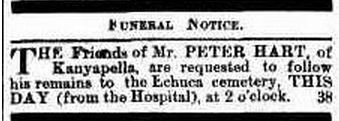
George M Rathbone, author of a book “From Wheels to Wings – 1822 – 1986″, was a grandson of my great great grandparents, Agnes Mason and Peter Hart.
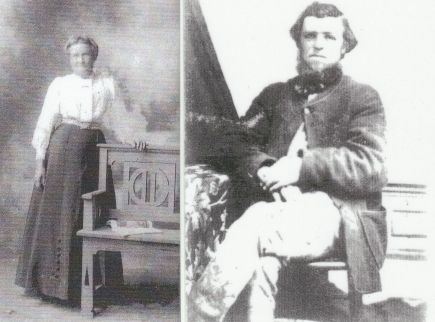
Agnes Mason and Peter Hart
Peter was a miner for a while at Talbot in Victoria.
Agnes was the daughter of Peter Webster Mason and Margaret Leslie Mason nee Carstairs from Scotland.
The following is an excerpt from George Rathbone’s book
“Peter Webster Mason, his wife Margaret and family travelled the gold escort route to Ballarat. There they became friends with William Rathbone and the Martin brothers James, his wife Virtue and their baby son Isaac. Baby Isaac died somewhere along the inhospitable track. Isaac Martin and his wife Jean (nee Cromers). William Rathbone later married Elizabeth Martin, James Martin’s sister.
In the early years so scarce were women on the goldfields that at the appearance of one, the miners would shout “there’s a woman”. So the Mason and Martin families were drawn together for comfort and refuge.
None of the friends had any great gold finds, only sufficient to satisfy their needs.
The families were fortunately away from the Ballarat goldfields at the time of the Eureka Stockade.
~~~~~~~~
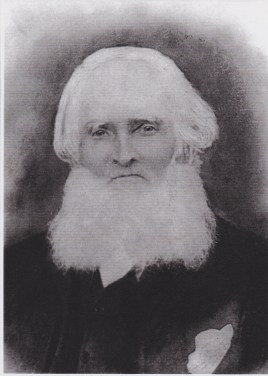
William Finlay Fleming
He started mining at the Bendigo and Clunes district of Victoria.
Although he was not very successful he secured one fine nugget which turned the scale at 3lbs 2oz.
He moved on to farming after about 18 years on the gold fields,